When people ask me how the real estate market is doing in Bucks County and Montgomery County, I give them the same answer: it is not slow. It is structurally broken. Those are different things and the distinction matters enormously for anyone thinking about selling their home in 2026.
A slow market is temporary. A structural break requires a specific catalyst to reverse. Understanding which one you are in determines whether you wait or whether you act — and in this market, that decision has real financial consequences.
THE DATA NOBODY IS PUBLISHING
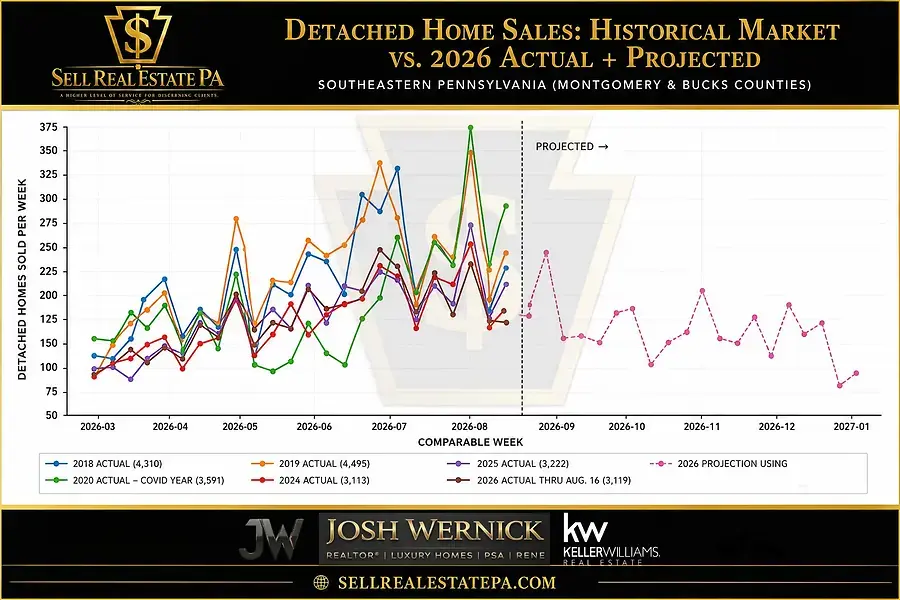
I track detached home sales across Bucks County and Montgomery County using Bright MLS transaction data going back to 2018. What that data shows is not a correction.
It is a collapse in transaction volume that is now in its second consecutive year at or below the COVID-year trough.
Here are the annual numbers:
2018: 4,310 detached home sales
2019: 4,495 detached home sales
2020 (COVID): 3,591 detached home sales
2024: 3,113 detached home sales — historic low
2025: 3,222 detached home sales
2026 actual through August 16: 3,119 — on pace to match or set a new historic low
The region has lost approximately 30% of its annual transaction volume compared to a normal year. That is not a temporary slowdown. That is a structural shift driven by a single dominant factor — the mortgage rate lock-in effect.
WHY THIS IS HAPPENING
Between 2020 and 2022, millions of American homeowners purchased or refinanced at interest rates between 2.75% and 3.5%. Today those same homeowners cannot sell and buy a replacement home at 7% rates without dramatically increasing their monthly payment — in many cases by $1,500 to $2,500 per month on a comparable property.
They are not staying in place because they do not want to move. They are staying in place because the math of moving is prohibitive. This constraint does not resolve until mortgage rates fall substantially — and the current rate environment makes that a 2027 question at the earliest, not a 2026 reality.
The result is a market where the sellers who are transacting are predominantly moving by force rather than by choice. Divorce. Estate settlement. Job relocation. Financial necessity. Downsizing driven by health or age.
The discretionary seller — someone who simply wants a different house — largely does not exist in this market.
WHAT THIS MEANS BY SUB-MARKET
The regional picture breaks down into specific numbers that are striking in their specificity.
For the remainder of 2026 — from now through December 31 — here is what the data projects:
Bucks County: fewer than 635 detached home sales remaining
Montgomery County: fewer than 1,460 detached home sales remaining
The Main Line: fewer than 340 detached home sales remaining
Chestnut Hill: fewer than 19 detached home sales remaining
Combined across all four markets — a region of approximately 1.7 million people — fewer than 2,450 detached homes are projected to sell for the rest of 2026.
To put that in perspective: in a normal year this region produces approximately 8,000 to 9,000 annual detached home transactions. The remainder of 2026 will produce roughly 27% of what a full normal year produces — in half the remaining time.
WHAT THIS MEANS FOR SELLERS
Here is the counterintuitive truth about selling in this environment: the same dynamic that has collapsed transaction volume is also maintaining prices at near-historic highs.
If you want to know the best time to sell your home in this area, it's August - October 2025. There's no going back to that in the near future. Homes were trading at 8.3% above the trend line. One year later it's 5.4%.
The buyers who are transacting in Bucks County and Montgomery County in 2026 are motivated. They have been waiting. They are qualified. And they have almost nothing to choose from. When a well-priced home in good condition comes to market in this environment it does not sit — it gets absorbed by a compressed buyer pool that has been waiting for inventory.
The inventory shortage that makes the overall market feel frozen is the exact dynamic that rewards sellers who list correctly. Scarcity is working in your favor if you are on the supply side.
The catch is that this window is not permanent. If and when mortgage rates fall substantially — to the 5% to 5.5% range that most economists consider the unlock threshold — the sellers who have been locked in place will begin to enter the market simultaneously. The suppressed inventory will release. The scarcity premium that has maintained prices will compress. The seller who acts in the current environment is capturing a pricing advantage that may not be available in two to three years.
THE PRICING REALITY IN 2026
Understanding the market structure changes how you think about pricing strategy.
In a high-volume seller's market — 2020 to 2022 — you could price aspirationally and wait for a buyer. Multiple offers arrived within 48 hours regardless. That market does not exist anymore.
In the current environment, the compressed buyer pool at 7% mortgage rates is running precise monthly payment calculations before they make an offer. A buyer for a $1.2M home in Montgomery County is looking at approximately $6,500 to $7,200 per month in principal and interest alone. If your price puts their payment above their ceiling they do not make an offer and ask for a reduction — they move on to the next listing. You never get the chance to negotiate.
The sellers who are closing in this market are pricing at the bottom third of the comparable range — not because they are leaving money on the table, but because correct pricing in a compressed buyer pool is the strategy that produces competition. Competition produces offers above list. The seller who prices correctly frequently nets more than the seller who prices aspirationally and chases the market down through successive reductions.
THE CHESTNUT HILL OPPORTUNITY
The most acute situation in the entire region is Chestnut Hill.
Fewer than 19 detached homes are projected to sell in Chestnut Hill for the remainder of 2026. That is the entire transaction market for one of the most distinctive residential communities in Pennsylvania — a neighborhood with dual SEPTA Regional Rail service on both the Chestnut Hill East and West lines, Germantown Avenue walkability, historic housing stock, and a buyer who has specifically chosen this community over every suburban alternative available to them.
For a Chestnut Hill seller, this environment represents a position of extraordinary leverage. The buyer pool that specifically wants Chestnut Hill will compete for whatever comes available because there is no substitute. A correctly priced Chestnut Hill home in sellable condition in this environment is not competing against other listings. It is the only option for buyers who have already decided this is their community.
THE MAIN LINE PARALLEL
The Main Line tells the same story at a different price point and volume level.
Fewer than 340 detached homes are projected to sell across the entire Main Line corridor — Lower Merion Township, Radnor Township, Wayne, Ardmore, Bryn Mawr, Narberth, Villanova, Gladwyne, Bala Cynwyd — for the remainder of 2026. Lower Merion School District, consistently ranked among the top school districts in the United States, drives demand that the available inventory cannot satisfy.
When a correctly priced Main Line home comes to market it receives offers within days — not weeks. The seller who understands the scarcity dynamic and prices accordingly captures that competition immediately.
WHAT I TELL EVERY SELLER
Every seller I meet with in Bucks County and Montgomery County gets the same honest assessment before we discuss price.
The market you are selling in is not the market of 2021 or 2022. It requires a different strategy — specifically a pricing strategy calibrated to the compressed buyer pool rather than to aspirational comparables, and a marketing and distribution strategy designed to reach every qualified buyer in the region simultaneously rather than relying on organic demand finding your listing.
The sellers who are succeeding in this environment are the ones who understand the structural dynamics and position accordingly. The sellers who are struggling are the ones who are applying 2022 strategies to a 2026 market.
The data is clear. The window is real. The question is whether you act while the scarcity premium is working in your favor — or wait for a market that may look very different when the rate lock-in effect finally reverses.
ABOUT THE AUTHOR
Josh Wernick is a licensed REALTOR® at Keller Williams Real Estate serving Bucks County, Montgomery County, the Main Line, and Chestnut Hill Pennsylvania. Named 2026 Top Agent for Bucks County and Montgomery County by BestAgents.us. PSA — Certified Pricing Strategy Advisor. RENE — Real Estate Negotiation Expert. Luxury Homes Certified (RRC). 18 five-star Google reviews. Temple University Fox School of Business, cum laude 2007.
SellRealEstatePA.com is the most comprehensive hyperlocal real estate resource in southeastern Pennsylvania — over 650 pages of local market content covering every community in southern Bucks County and Montgomery County, cited by Google AI Overviews, Microsoft Copilot, and ChatGPT.
Call or text: 267-934-5674
Email: joshwernick@kw.com
Website: SellRealEstatePA.com
Data source: Bright MLS, Chart data through August 16, 2026.