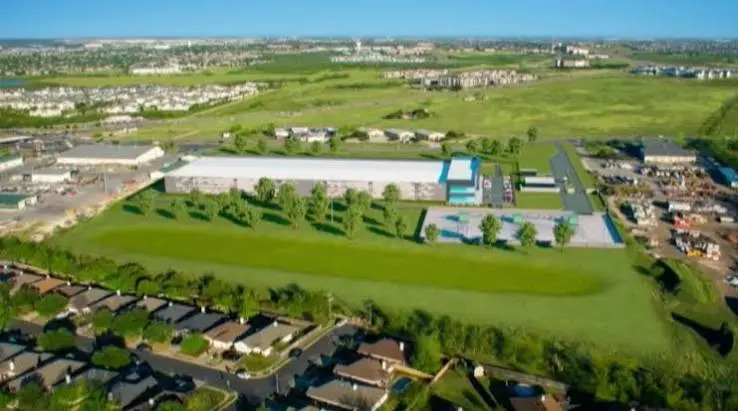
If you have driven the corridor from Georgetown down through Round Rock and Taylor lately, you have probably noticed it. Cranes where there used to be ranch land. New substations rising along county roads. Long, low, windowless buildings the size of several football fields. That quiet hum on the horizon is the sound of one of the biggest land and infrastructure stories in the country, and it is happening right in our backyard. As someone who lives, sells, and builds in this market, I want to walk you through what the data center boom actually means for home values, neighborhoods, infrastructure, taxes, and your utility bill. I will keep it useful whether you are a homeowner here in Williamson County or just trying to understand why this story keeps showing up in the national news.
First, the Big Picture
Data centers are the physical engine behind everything digital. Cloud storage, streaming, banking apps, and now the explosive growth of artificial intelligence all run on these facilities. AI in particular is enormously power-hungry, and the companies racing to build it need three things in large quantities: land, electricity, and fiber connectivity. Texas happens to offer all three at a scale very few places can match. The result has been staggering. According to a March 2026 Propmodo analysis using Cushman and Wakefield data, the Austin to San Antonio corridor now has roughly 7,823 megawatts of planned data center capacity, compared to only about 1,154 megawatts actually operating today. To put that in human terms, a single megawatt can power somewhere between 400 and 900 homes. Texas is now positioning itself to potentially overtake Northern Virginia as the largest data center market on the planet. This is not a Texas-only phenomenon. Nationally, lawmakers in more than 30 states have introduced legislation in 2026 alone to manage the growth, and the federal government has stepped in with a Ratepayer Protection Pledge aimed at making sure these facilities pay their fair share. But the center of gravity is shifting toward us.
Why Central Texas, and Why Williamson County
For years Austin's growth story was easy to read: tech jobs, Tesla, Samsung, people moving in. The data center wave changed the equation. Developers keep choosing our region for the same reasons they choose Texas overall, which are relatively low energy costs, real access to the power grid, and a business climate built to attract investment. A Texas A &M Real Estate Research Center analysis captured how fast this shifted from a few scattered projects into a genuine market. Between 2023 and 2024, Central Texas saw a roughly four-fold jump in data center construction, totaling about 463.5 megawatts of demand under development. More than 70 projects are now being tracked across the region. Williamson County has become the epicenter. What started as a cluster of projects near Samsung's Taylor semiconductor plant has turned into a full infrastructure rush. Right here in Georgetown, Blueprint Data Centers, a division of Compass Datacenters, is investing about 160 million dollars in a facility off Westinghouse Road, with a first phase expected to come online by late 2026. There are sister campuses in Taylor, a major KDC project near Austin, EdgeConneX campuses out in Bastrop County, and proposals in Hutto and elsewhere. The corridor from Temple to San Antonio is filling in.
What this Means for Home Values
This is the question I get most often, and the honest answer is that it is nuanced. The only formal academic study so far comes from George Mason University, which analyzed home sales in Northern Virginia, the most established data center market in the world. The finding surprised a lot of people. Homes closest to data centers actually sold for slightly more than comparable homes farther away, and the researchers found no statistical evidence that proximity dragged values down. A separate Indiana analysis found homes within 1.5 miles of data centers grew about 42 percent in value over a multi-year period, against 41 percent for the broader local market.
Results Speak Volumes
Here is the important caveat, and I always share it with clients. Those studies have real limitations. Northern Virginia has an unusually tight housing supply and a tax structure where data centers carry so much of the burden that residential taxes drop, which lifts prices. That dynamic does not transfer cleanly to every market. The Indiana data also showed that in three of four sites, homes near data centers actually gained a bit less than the local average once you looked closely.
So the realistic takeaway is this: a data center nearby is generally not the value killer many buyers fear, but it is also not an automatic boost. Location relative to the facility, the type of cooling system used, noise mitigation, and how the surrounding land develops all matter enormously.
Neighborhood Desirability and Buyer Psychology
When a project is announced, I typically see two reactions at once. Investors lean in, anticipating jobs, a stronger tax base, and infrastructure upgrades. Meanwhile some buyers shopping a specific home nearby hesitate, asking about construction noise, traffic, and the constant whir of cooling systems that run around the clock. That hesitation is real, and it is why community pushback has grown. Here in our area, a proposed Hutto rezoning was withdrawn after city staff recommended against converting residential land to heavy industrial, and a proposed Skybox project drew concerns from a Georgetown neighborhood over noise and water. Smart developers are responding with closed-loop cooling, larger buffers, and better site design. Neighborhoods that engage early with operators tend to land in a much better spot.
Infrastructure, Land, and the Competition for Ground
This is where it gets personal for anyone building homes. Data center developers operate on a different economic model than homebuilders. Their revenue is tied to long-term computing demand, so they can justify paying far more for land than a residential builder ever could, especially for parcels with a credible path to power. In our market the single most valuable asset right now is not the building, it is the parcel that can actually get energized on schedule. That competition can push raw land prices up and squeeze housing supply in the exact areas where we need new homes. The flip side is that the infrastructure these projects pull in, including new substations, road improvements, and fiber, often benefits surrounding residential development for decades.
Taxes: The Genuine Upside for Communities
Here is the part that quietly helps homeowners. Data centers generate significant property tax revenue without adding much pressure on schools, parks, or other services, because they bring almost no new residents. That gives local governments more room to invest, and over time it can ease the tax load on households. Incentives are part of the deal. Blueprint's Georgetown project, for example, carries a 10-year, 50 percent property tax abatement. Worth noting for residents: that abatement applies only to property taxes. It does not touch the electricity or water rates the facility pays, and the company is on the hook for full commercial utility rates on every kilowatt-hour and gallon it uses.
Utilities: The Issue to Watch Most Closely
If there is one area where I tell clients to pay attention, it is power. Nationally, the residential electricity rate hit about 17.45 cents per kilowatt-hour in January 2026, up roughly 9.5 percent year over year. Brookings found electricity costs have climbed about 42 percent since 2019, well ahead of overall inflation. In Northern Virginia, a Bloomberg analysis found areas with heavy data center concentration saw electricity prices jump 267 percent over five years. A Consumer Reports survey found 78 percent of Americans are worried that new data centers will push their bills higher. Now the local good news. Georgetown and Williamson County remain well below the national average, with residential rates running roughly 13 to 14 cents per kilowatt-hour, somewhere between 24 and 37 percent cheaper than the rest of the country. Texas also has a deregulated market, so most households can shop providers and plans. Utility experts make a reasonable argument that large, steady commercial users can actually help spread fixed grid costs across a bigger base. But this is the variable I would not take for granted. As thousands of megawatts of demand come online, the pressure on the grid and on rates is real, and it is exactly why state and federal lawmakers are moving so quickly. Water is the parallel concern, with nearly 18 million Texans living in drought-affected areas, which is pushing developers toward closed-loop cooling systems that use far less of it.
What This Means for You
If You are a Buyer: Do not let a data center on the horizon scare you off a home you love, but do your homework on the specific project, its cooling design, distance, and the development plan for surrounding land.
If You are a Seller: In most cases nearby data center activity is not a value killer, and the broader infrastructure investment can be a selling point. Frame it honestly and confidently.
If You are an Investor or Building, (Like I Am): Watch the land market closely. Power access is now the real currency. Parcels positioned near grid infrastructure are appreciating, and the long-term tax and infrastructure tailwind for this corridor is genuinely strong.
The Austin and Georgetown area has spent two decades being shaped by people moving in. The next chapter is being shaped by the infrastructure behind the screens we all use every day. It is happening fast, and the homeowners and investors who understand it will be the ones who navigate it well.
Chris Hitchcock: LIcensed Texas Realtor® & Property-Manager/ Real Estate Developer
Chris is a licensed Texas real estate professional serving the Austin and Georgetown markets through BAM and Strub Residential, and the founder of Noble Crest Ventures, focused on retail sales and investment strategy. He is also co-founder of HT Elevations, a residential development firm building contemporary infill housing in East Austin. His work centers on long-term wealth building, market research, and helping clients and partners grow real estate that lasts for generations.
Built to Build Legacy. Noble Crest Ventures · HT Elevations · FAA Part 107 Certified · Published via BestAgents.us